'%3E%3Cmask id='b' fill='%23fff'%3E%3Cuse xlink:href='%23a'/%3E%3C/mask%3E%3Cuse fill='%23414141' xlink:href='%23a'/%3E%3Cg mask='url(%23b)' fill='%23414141'%3E%3Cpath d='M-160-170h300v300h-300z'/%3E%3C/g%3E%3C/g%3E%3C/g%3E%3C/svg%3E)
It's Always Earth Day at TVA
Learn what we do to care for the land, water, forests and birds of the Valley region.
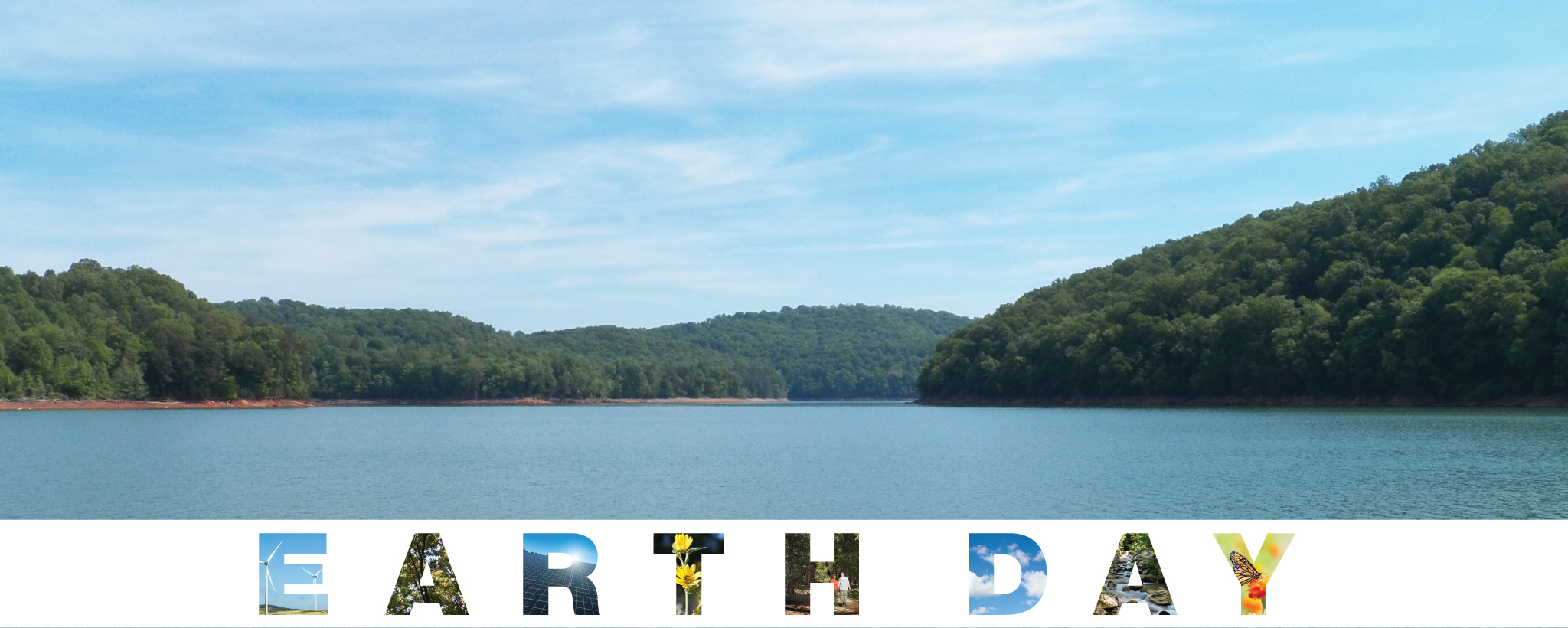
At TVA, Earth Day brings an opportunity to celebrate our hardworking environmental stewardship, with educational events and many volunteer opportunities where staff and volunteers work together to clean up the Tennessee Valley region.
In the Beginning
The first Earth Day, on April 22, 1970, was a unified response to multiple environmental crises — oil spills, smog, rivers so polluted they caught fire. This year we are called to learn about how we can help today’s environment.
Statistics show the Earth’s average temperature has become slightly warmer in recent years, and varying rainfall patterns have caused droughts in some parts of the country and floods in others. With decades of work studying rainfall patterns—including dendrochronology, the study of tree rings that can reveal rainfall amounts going back centuries—TVA’s river management system is set up to handle extremes.
“Our region has seen extreme variations in rainfall, from droughts to floods, over its history,” said Tom Barnett, vice president, TVA River Management and Dam Safety. “TVA is prepared to manage the Tennessee River for flood damage reduction, power generation, recreation, navigation, water quality and water supply.”
Extreme weather can bring an increased risk of wildfires. TVA helps reduce that risk with prescribed burns.
“When rainfall slows and weather conditions are right — we have plans prepared for conducting prescribed burns,” explained R. J. Moore, Natural Resources senior specialist. “They can reduce local fuels to help lower the risk of wildfires and provide removal of last years’ competition for native plants to thrive.”
Saving the Trees
Forestry has been part of TVA’s mission from the beginning. Since the early 1900s, the overall amount of forest area in the U.S. has remained constant at about 33% of the total land area. But today’s warming climate and steep population growth are issues early foresters could not have imagined.
Within its historical stewardship mission, TVA has supplied or planted approximately 1 billion trees and climbing across the Tennessee Valley region as part of afforestation, reforestation and land reclamation efforts.
Trees play a vital role in keeping Earth’s surface temperature regulated. Among the other benefits they provide such as wildlife habitat, trees have a cooling effect — not just by providing shade, but also through a process called “evapotranspiration.” Water moves into the tree’s roots from the soil and travels upward, eventually transpiring from the leaves in water vapor, cooling the surrounding air. Every new tree helps.
“We work with partners such as the University of Tennessee to plant trees in a planned, consistent and sustainable way,” said Anthony Summitt, senior manager, Natural Resources Management. “We’re working together to plant, grow, monitor and study a new generation of trees near TVA’s Norris Dam."
The grafting stock for the trees was collected from historic orchards which have favorable characteristics such as disease resistance, fruit and nut production and/or historical or cultural significance.
"It’s part of our commitment to create and sustain strong tree cover in strategic parts of the Tennessee Valley,” Summitt said.
Trees, shrubs and plants along our shorelines also play an important role in preserving nature. They decrease streambank and shoreline erosion, provide animal habitat and preserve water quality by helping to reduce soil and chemicals from washing into streams. With an increasing amount of Earth’s surface taken up by development, these buffers provide habitat for birds and animals displaced by it and create corridors for animals to move between habitat areas.
Watching the Birdies
Shifts in planetary climate affect all living creatures, and birds are no exception. Recent national studies have revealed troubling losses in the numbers of some bird species. In September 2019, the journal Science reported that the number of birds in the U.S. and Canada has fallen by 29% since 1970. That means there are 2.9 billion fewer birds in the skies than there were 50 years ago.
There are likely many causes, including loss of habitat. The losses affect not just birds known to have been endangered, such as bald eagles, but also common birds such as robins and sparrows.
This is why TVA’s ongoing work to protect and improve bird habitat on its 293,000 acres of managed land is so important.
“We’ve been aware of fluctuations in bird populations here in the Southeast for many years,” says Damien Simbeck, senior program manager in TVA Natural Resources. “TVA has been working with numerous partners for a long time to improve and restore many habitat types to benefit a variety of bird species. We have initiatives to improve grassland habitats, short-leaf pine stands, wetlands and bottomland hardwood forests. We also work in many areas to control or remove non-native, invasive plant species and restore native plant communities.”
No matter what new factors come along—rainfall, temperature or anything else—a key part of TVA’s mission remains environmental education. TVA is committed to teaching the next generation to care for the earth and protect it for future generations.
Share this story: ' fill='%23414141'%3E%3Cpath d='M0 0h314v314H0z'/%3E%3C/g%3E%3Cg transform='translate(6 4)'%3E%3Cmask id='d' fill='%23fff'%3E%3Cuse xlink:href='%23c'/%3E%3C/mask%3E%3Cuse fill='%23FFF' xlink:href='%23c'/%3E%3Cg mask='url(%23d)' fill='%23FFF'%3E%3Cpath d='M-149-165h300v318h-300z'/%3E%3C/g%3E%3C/g%3E%3C/g%3E%3C/svg%3E%0A)
' fill='%23414141'%3E%3Cpath d='M0 0h314v314H0z'/%3E%3C/g%3E%3Cg transform='translate(4 5)'%3E%3Cmask id='d' fill='%23fff'%3E%3Cuse xlink:href='%23c'/%3E%3C/mask%3E%3Cuse fill='%23FFF' xlink:href='%23c'/%3E%3Cg mask='url(%23d)' fill='%23FFF'%3E%3Cpath d='M-167-171h323v327h-323z'/%3E%3C/g%3E%3C/g%3E%3C/g%3E%3C/svg%3E%0A)
' fill='%23414141'%3E%3Cpath d='M0 0h314v314H0z'/%3E%3C/g%3E%3Cg transform='translate(4.26 4)'%3E%3Cmask id='d' fill='%23fff'%3E%3Cuse xlink:href='%23c'/%3E%3C/mask%3E%3Cuse fill='%23FFF' xlink:href='%23c'/%3E%3Cg mask='url(%23d)' fill='%23FFF'%3E%3Cpath d='M-150-157h300v300h-300z'/%3E%3C/g%3E%3C/g%3E%3C/g%3E%3C/svg%3E)
We Value Our Volunteers!
There are many ways you can help us care for the Valley region. In addition to volunteer opportunities, here are some ways you can help individually every day.
- When you walk or hike, take a trash bag with you and see if you can fill it up.
- Plan a wildflower garden.
- Plot where you can place a native tree or shrub in your yard.
- Build a birdhouse, or set out something birds can use for a birdbath.
- Take photos of birds and wildlife close to home, and share them on iNaturalist.
Learn more about recreation on TVA lands at TVA.com/Recreation.